
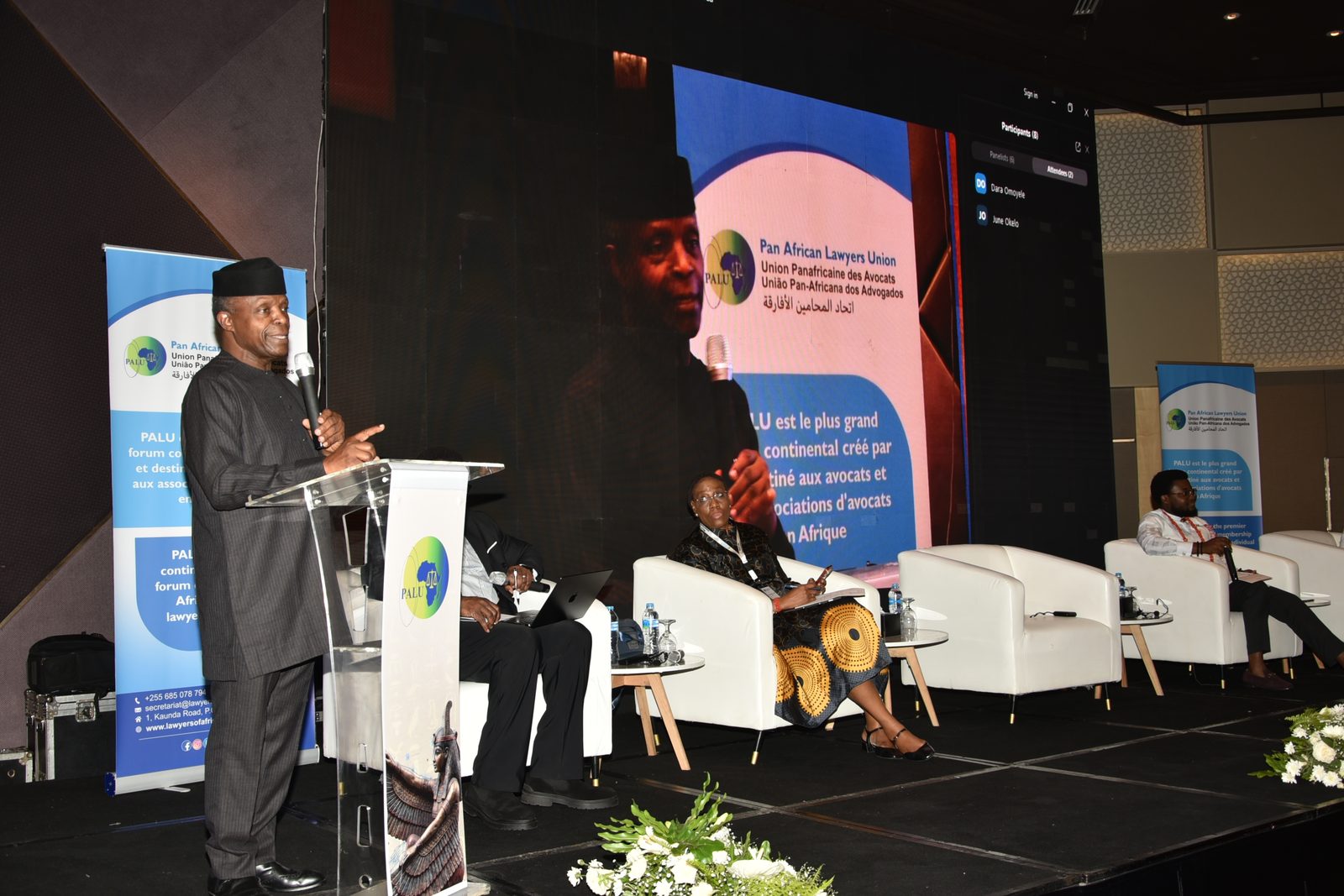
Justice Research Institute convenes a PALU session to develop the Cairo Declaration on Child Rights and Design Accountability in the Digital Age.
CAIRO, EGYPT — Lawyers, judges, regulators, policymakers and child-rights advocates from across Africa have taken a step towards a continental framework for protecting children online.
The Justice Research Institute (JRI), working with the African Alliance for People-Centred Justice (AAPCJ) and supported by Luminate, convened a high-level session on Monday at the 16th Annual Conference of the Pan African Lawyers Union (PALU) in Cairo to deliberate on the proposed Cairo Declaration on Child Rights and Design Accountability in the Digital Age.
The session, titled “Guardrails, Not Gates: Protecting Children in the Digital Age,” was chaired by Prof. Yemi Osinbajo, SAN, former Vice-President of Nigeria.
Where responsibility should sit
Discussions centred on who should bear responsibility when digital products and artificial intelligence systems built for children expose them to exploitation, manipulation, harmful content and excessive data collection.
Participants agreed that children should not carry the burden of risks created by systems they did not design, and that responsibility should instead rest with technology companies, platforms and developers whose design choices shape children’s digital environments.
Experts reviewed the scale of emerging digital risks facing African children, and a moderated debate examined three tensions facing regulators: protecting children without excluding them from digital life; regulating platforms without stifling innovation; and safeguarding children without resorting to excessive surveillance.
Six pillars under review
Delegates then held table discussions to review, amend and rank six proposed pillars of the declaration:
- 01Safety-by-design obligations for digital platforms and products used by children.
- 02Prohibition of exploitative targeting and manipulative practices directed at children.
- 03Age-appropriate design codes reflecting children’s developmental needs and rights.
- 04Algorithmic accountability and transparency for systems that amplify harmful content.
- 05Data sovereignty and protection of children’s personal information.
- 06Age assurance and verification mechanisms that respect privacy and other rights.
Guardrails, not gates
Osinbajo said Africa’s response to online risks must move beyond placing the burden of safety on children and parents.
We cannot build digital environments in which the risks are engineered into the product and then expect children and parents to carry the responsibility for managing those risks.Prof. Yemi Osinbajo, SAN
He argued that regulation should not exclude children from the digital world but should ensure that world is designed with their safety and development in mind.
The objective is not to build gates that exclude children from technology. It is to establish guardrails that ensure technology works for children rather than exploiting their vulnerabilities.Prof. Yemi Osinbajo, SAN
At the end of the deliberations, a consolidated draft of the declaration, incorporating delegates’ amendments, was presented to PALU’s leadership for consideration. The initiative also plans model legal and regulatory instruments that African legislatures, data protection authorities and regulators can adapt locally.
Shaping the rules, not only reacting to harm
Foluso Idumu-Shado, Director of People-Centred Justice at JRI, said the Cairo initiative reflects the need for African policymakers and lawyers to move from reacting to digital harms to shaping the rules that govern digital design.
Children in Africa are entering a digital environment largely designed elsewhere. We must ensure that African children are not merely protected from the consequences of technology but that their rights and interests are considered in how digital technologies are designed, deployed and regulated.Foluso Idumu-Shado, Director of People-Centred Justice, JRI
“A people-centred approach requires us to ask a simple question: does the digital environment serve the best interests of the child? If it does not, then the law must require those who design and profit from these systems to change the way they operate,” Idumu-Shado added.
She said the proposed declaration allows African lawyers, regulators, civil society and technology stakeholders to agree a common continental position, while individual countries retain room to develop context-specific legislation.
A continuing working group
The Cairo session also set up a continuing working group on child-centred digital governance, open to PALU delegates, member bars and other experts.
JRI will serve as technical secretariat, supporting further consultations and the development of model legal instruments. Progress on the declaration will be reviewed at PALU’s 17th Annual Conference.
The declaration is intended to anchor an emerging African consensus that children’s rights must be protected not only through rules on how technology is used, but through accountability for how it is designed.